
The three-and-a-half things I learned about French football this year
An American gets a cultural education

I moved to Paris just as the 2025-26 Ligue 1 season was getting started, and after watching many games, drinking many 1664s, and suffering a long, dark European winter, I have many thoughts. Not least of which is that diehard French football fans really—and I mean really—no, really, really—hate Americans owning their teams.
That’s not very interesting or revelatory. Americans have owned my Philadelphia Phillies for all of the club’s history, and we’re on pace to win a championship every 71.5 years. When it comes to winning, we’re not very good at or interested in it. The disdain is understandable and with this writer it is shared.
So for the list below, I plumbed the deeper neurons that French beer failed to zap, reaching for observations about the game that reflect French society or the economics of the sport. I can’t wait for season two.
1.a.) Ligue 1 reminds me of Major League Soccer
This is probably the meanest thing I could say about Ligue 1, considering I wrote an article called “Can we all just admit that MLS is terrible?”, but both leagues feature cheap, young players destined for foreign shores and over-the-hill veterans clinging to top-tier football. (Cheers to you, Olivier Giroud.) As in real life, there is no middle class.
Both leagues also feature football that can be dreadful. I covered the launch of MLS’s San Diego FC, including the signing of their first-ever player in Duran Ferree, and three years later he did this:
At the Stade Jean Bouin, I watched RC Lens toy with an undersized and unprepared Paris FC. Under now-former coach Stéphane Gilli, PFC looked as enthused to be in the February cold as I was. The 5-0 final score somehow doesn’t indicate how poorly one side played—and that side is a mid-table team!
Finally, both Ligue 1 and MLS love a harebrained corporate sponsorship. Who thought making the official name “Ligue 1 McDonald’s” was a good idea? It must have been the same guy—it’s always a guy—who thought people would pay Apple $100 to watch MLS. And that same guy must have went back to Ligue 1 and told them to start a subscription service that costs no less than €120 per season.
1.b.) But Ligue 1 has the history, infrastructure, and talent to be an elite league (again)
Ligue 1 is one of Europe’s Big Five leagues for a reason, and it is, in fact, not terrible. That’s mostly because of the amount of elite football talent that France produces and in turn is fed into the French football system. I am certain that a team comprised only of players from Paris’ suburbs could compete for trophies.
Take Eli Junior Kroupi. Though not from the Île-de-France region, Kroupi is one of, if not the best teenage goal scorer that the Premier League has ever seen, and he’s driving AFC Bournemouth into Champions League contention. Kroupi was not a Paris Saint-Germain product who couldn’t find minutes in a crowded locker room. He came through the academy at Lorient. A yo-yo club in a small city out in Brittany producing such an elite player speaks to the quality in the French football ranks. That talent might not stay in France very long, but it’s there.
It’s also been amazing to learn about the savvy and refined Lorients of the world, and the industrial Saint-Étiennes and the left-wing Red Stars and all the other “small” clubs that are scattered throughout France. As I joked in a piece at the start of the season, I knew “far more about Wolverhampton Wonderers, a putrid EPL side in a city I can’t place on a map” than I did any French club not named PSG.
It’s easy to be nostalgic for a time that I didn’t experience (or that never really existed in the first place), but there’s something romantic about French football’s modern dynasties. Saint-Étienne in the 1960s and 70s made way for Bordeaux, which made way for Marseille, which made way for Lyon, which made way for PSG. Va-Va-Voom, Tom Williams’ history of French football, is an essential resource to learn about these clubs, whose rises and falls track closely with the prospects of their host cities.
As a business, Ligue 1 is in rough shape, but as an idea—as a thing that animates the culture and that once was and could be again—French club football is incredible.
2.a.) More than anything, Paris Saint-Germain is a consumer brand
From the outside looking in, PSG’s dominance was typical. A major club was bought by multi-billionaires, and now fans outside of Paris complain about them winning everything. Up close, PSG is more interesting and less substantial than I thought.
PSG is relatively young, having formed in 1970, and before the Qataris took over in 2012 it was a competitive, if unremarkable club. They had won a couple league titles and a handful of cup competitions. Other French teams were both more popular and more successful.
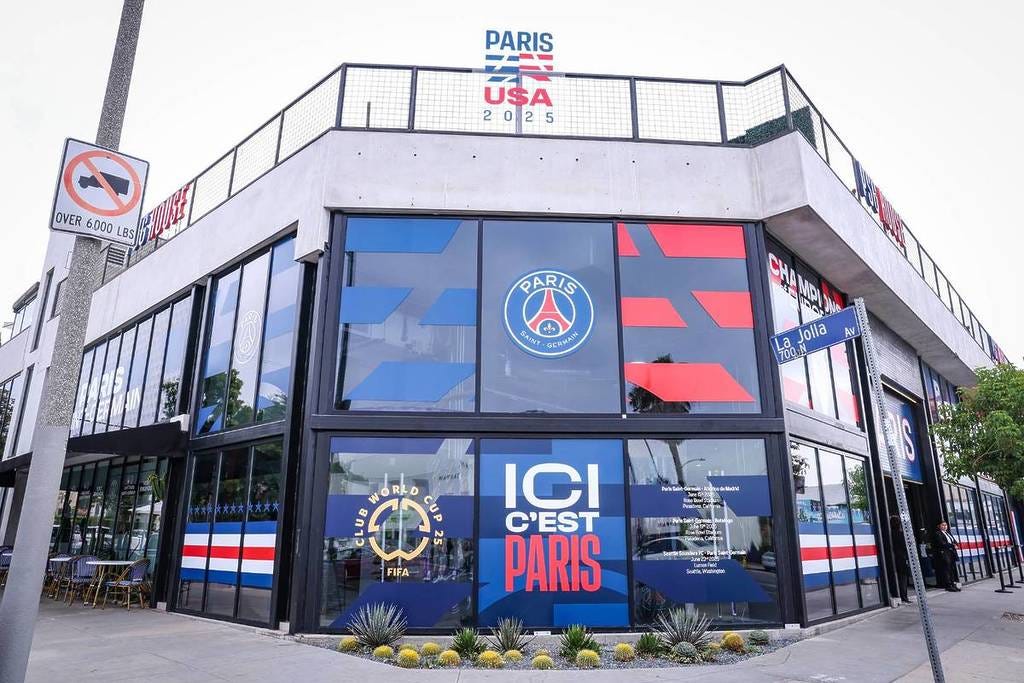
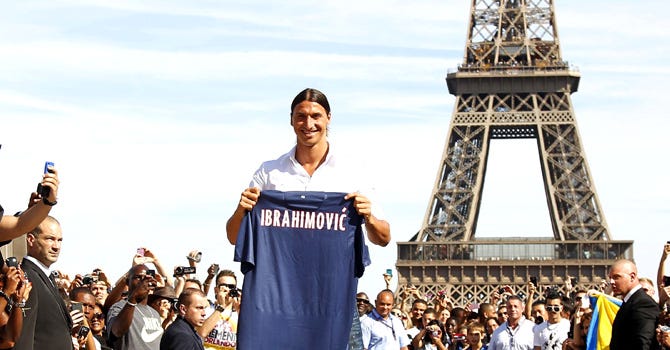
But no other Ligue 1 team was in Paris. What the Qataris realized is that the city itself could be leveraged to build a world-conquering brand, and that’s exactly what PSG is today. Only PSG gear is in the airports. Only PSG has retail outlets in cities around the world. Only PSG has a partnership with [checks note] WWE. PSG feels everywhere and inevitable, at the same time as it feels luxurious and a little unattainable—just like its host city. The club doesn’t play near the Eiffel Tower, but it features prominently in its logo and it’s where the club introduces new players.
That’s not to diminish the ultras and the generations of Parisians who have supported the club. (I suspect many grin-and-bear the Qataris’ marketing schemes and conspicuous, fossil fuel-based spending.) I just thought I would resent PSG more than I do. Outside of the core supporters, ‘Paris Saint-Germain’ is a luxury brand meant to make people with disposable income feel good. Opposing PSG would be like standing outside of and taunting a Chanel store—pointless and gratuitous. I even kind of respect the genius to turn a decent club soccer team in Paris into an entity that can host yoga classes in a high-end, pop-up concept store in London.
This is also not to diminish the players and what they’ve accomplished for the club’s fans. This Tottenham supporter hopes PSG beats Arsenal in the Champions League final and repeats as European champions. But to the club’s owners, winning isn’t the point. It’s only the fuel for a sleek and shiny international brand that, to me, is hard to feel passionate about in one way or the other.
2.b.) But the perennial challenge to the Ligue 1 throne is fun
Hot take: PSG’s dominance isn’t ruining French football, and seeing year-to-year which club rises to nip at PSG’s heels is fun and great. It’s not unlike my argument for why the Los Angeles Dodgers, winners of two consecutive championships and the highest spenders in MLB, are not ruining baseball.
This year, it’s RC Lens who are pushing the European champions. Lens will probably fall short, but Monaco didn’t in 2017. And Lille didn’t in 2021. They are miraculous, memorable seasons because of and not despite PSG’s dominance. We humans respond to story, and no story is more dramatic than the small/good guys beating the big/bad guys. That’s why they included it in the Bible.
If you don’t agree, then I urge you to watch MLS, whose parity is underwhelming and disorienting. I include in that suggest a hold harmless cause, for I don’t want to be held responsible for subjecting people to American soccer.
3.) Rugby competes with football for eye balls
When I first got to Paris, I went to a bar and asked the staff to put on one of the football games. They said they could, but only until the rugby started. It was a sentence I had never heard before, and I’d come to learn that rugby union is incredibly popular in France and is arguably the country’s second-most popular spectator sport,1 (though basketball, tennis, and cycling could make claims).
What does this mean? Maybe nothing. But it’s a fascinating and unique bit of culture, and one that could offer lessons to Ligue 1. The Top14, France’s premium rugby league, is growing like kudzu vine, with the Irish Times describing it as rugby’s answer to the Premier League. “France’s Top14 has a lucrative TV deal, record crowds and a thriving second division,” the paper wrote, all things that Ligue 1 would kill for.
4.a.) Ligue 1’s business model is broken
I’ve written about it before in these pages, and it’s a topic well-covered in sports media, but it’s worth reiterating that Ligue 1 and many French clubs are more or less bankrupt. The disastrous Mediapro deal in 2019, the Covid pandemic, and the private equity-ization of sports have riddled French football with debt, hampering its ability to invest in itself and compete in the sports marketplace.
For some reason, French football authorities keep doubling down on garnering broadcast revenue, whether that’s selling broadcast rights or producing broadcasts themselves and selling subscriptions. It has worked for other leagues, the Premier League most notably, but French football still can’t figure out how to stay on TV and remain relevant on an international level. In the U.S., the world’s greatest consumer market, French football basically doesn’t exist.
4.b.) And therein lies the opportunity
At first, I was surprised by how inaccessible French football is to Anglophones. Besides a well-produced English language Ligue 1 site, there aren’t many major platforms for Anglophones to consume Ligue 1 or French football. Now, I think they should lean into that.
French football should be marketed as exactly that—French. After all, it’s the only version of football that can be. Can’t speak French? Too bad, you’re missing out. (That’s the attitude of many Parisians, anyway.) Can’t reach international markets? So what, we have fans (and potential fans) in France. Change the name to Ligue 1 Carrefour. Throw a party, so to speak, for the French football fan, and make me as an Anglophone peek jealously over the fence. Make me want to join. Indulge in the exclusivity that drips from Parisian culture.
Wait, is this me saying French football should take a page out of PSG’s book? Red Star fans are going to excommunicate me.
Ligue 1 averages about 28,000 spectators per game. Last year, the top rugby league averaged over 16,000 per match, with nearly 3 million total attendees.